A Retail and Consumer-Goods Legacy Bigger Than Most People Realize
Bradenton carries more national commercial history than its size would suggest. Tropicana Products was founded in Manatee County in 1947 by Anthony T. Rossi, starting as a fruit-shipping and gift-basket business before pioneering pasteurized, not-from-concentrate orange juice in the 1950s — and the company remains headquartered in Bradenton today. Bealls department stores trace back even further, founded in the county in 1915, and the chain is still headquartered in Bradenton as a long-running Florida retail institution. Both are reminders that Bradenton has been a genuine commercial hub for the better part of a century, not just a bedroom community that happened to grow.
Two headquarters of that caliber, still operating out of a city this size more than a hundred years after Bealls first opened its doors here, says something about the depth of Bradenton's commercial footprint. It means a real base of established offices, warehouses, and support businesses tied to those companies alone — on top of the wider retail and office growth the city has seen more recently — all of which periodically needs the kind of cleanout and disposal work we do.
A City Still Growing
That commercial base keeps expanding alongside the city itself. Bradenton's population stood at 55,698 at the 2020 Census, and the U.S. Census Bureau's July 1, 2025 estimate puts it at 58,014 — a 4.1% increase in five years, packed into a compact 14.44-square-mile city that already runs at a population density of roughly 3,883 people per square mile. Growth like that brings more retail buildouts, more office turnover, more property management contracts, and more businesses expanding, relocating, or renovating their space — every one of which generates the kind of commercial cleanout and construction debris we haul on a regular basis.
From Farmland to a Diversified Economy
Bradenton and Manatee County didn't start as a commercial and retail hub — the area's roots are agricultural, built on celery, citrus and tomato farming before the local economy diversified into food and beverage manufacturing and, eventually, tourism. Tropicana and Bealls both trace directly back to that earlier era, and their continued presence here today is really a story about a working agricultural economy gradually layering commercial and industrial activity on top of itself over a century, rather than one replacing the other overnight. That layered history is part of why Bradenton's commercial building stock spans everything from mid-century retail buildings to brand-new office and light-industrial development — and cleanout jobs look different depending on which era of building you're clearing.
What a Commercial Cleanout Usually Involves
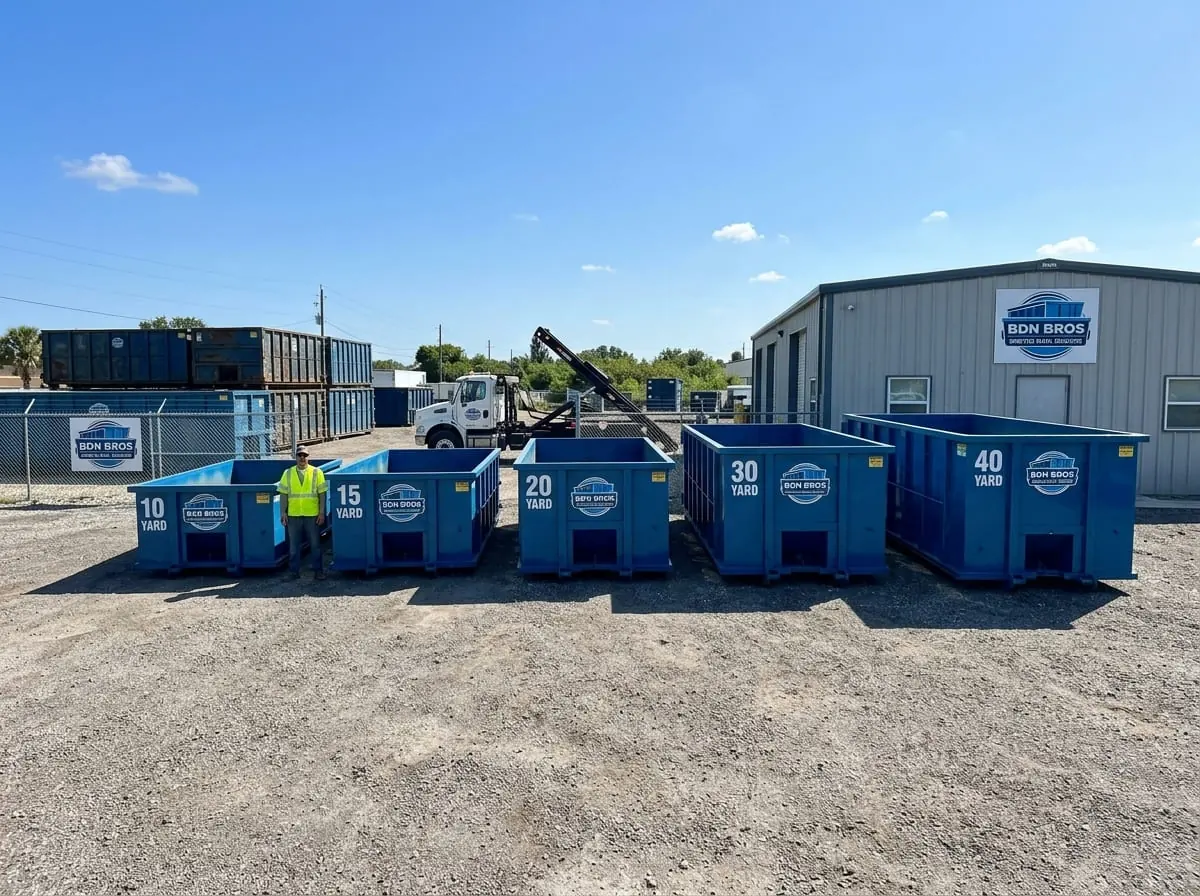
Commercial jobs tend to look different from residential ones in a few consistent ways: more uniform material (office furniture, cubicle partitions, carpet tile, drop ceiling grid, drywall from a build-out) rather than the mixed household debris of a home cleanout; larger overall volume, especially on a full office or retail build-out; and a much tighter tolerance for downtime, since every day a commercial space is unusable is a day of lost business. A property manager clearing out a vacated retail unit before a new tenant moves in, a business consolidating offices, or a contractor handling a full commercial build-out all need the same thing: a container sized right for a bigger, more uniform load, delivered and picked up on a schedule that respects the business's operating hours.
The uniformity of commercial debris is actually an advantage when it comes to sizing: because the material tends to be one or two consistent types rather than a mixed household pile, it's usually easier to estimate volume accurately ahead of time from square footage and the scope of the build-out or teardown, rather than guessing at what an unknown mix of belongings will add up to.
Scheduling Around a Business, Not the Other Way Around
We understand a commercial dumpster can't just sit wherever's convenient for us — it has to sit where it doesn't block a loading dock, doesn't interfere with customer parking during business hours, and doesn't create a liability issue on a property that's still operating. Tell us about the site — parking layout, loading access, business hours — when you call, and we'll plan delivery and placement to work around the business, not disrupt it.
One Container, Sorted Right
Whether it's a single office suite cleanout or a full retail build-out generating multiple loads over several weeks, the same standard applies: material gets sorted and routed responsibly, not just hauled to the nearest available spot, consistent with how Florida's own construction and demolition debris rules expect C&D material to be handled once it leaves your site.
For property managers handling turnover across multiple Bradenton commercial spaces, that consistency matters even more than it does on a single one-off job. Knowing that every unit gets the same disposal standard, the same scheduling flexibility around your tenants' move-out and move-in dates, and the same straightforward flat pricing removes one more variable from an already busy commercial calendar.